
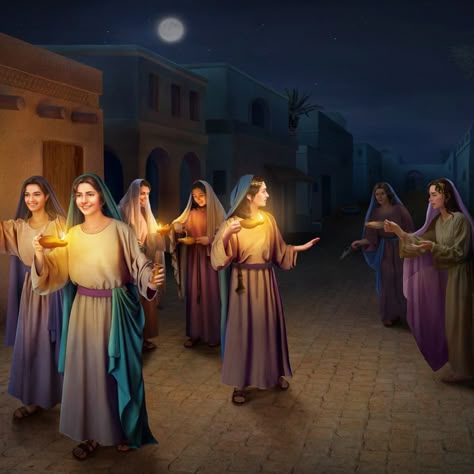
Viewing the parable of the ten virgins in Matthew 25 through the lens of Hebrew, Aramaic, and Jewish wedding practices reveals a more nuanced understanding versus traditional interpretations. True to authentic Second Temple Jewish wedding customs, the Cochin Hebrew Matthew and the Peshitta (Syriac translation) preserved a significant detail: The virgins go out to meet both bride and groom. By situating the parable within its original covenantal context, this cultural and textual fidelity suggests a Hebrew language origin.
Jewish Wedding Practice and the Virgins’ Role
Ancient Jewish weddings typically occurred in two stages:
- Kiddushin (Betrothal): A binding arrangement in which the bride and groom were legally married, but the bride remained in her father’s house.
- Nisuin (Marriage / Wedding Feast): The groom, accompanied by friends and attendants, goes to fetch the bride and escorts her to the groom’s house or wedding hall.
The virgins or bridesmaids (bitulot/almot) were part of this second stage. Though they themselves are not getting married, the virgins were tasked with escorting, celebrating, and honoring the bride and groom, a role that was ritualistic yet essential, ensuring the public completion of the covenant of marriage.
Greek vs. Semitic Witnesses
(Click on the image below to enlarge.)

- Greek Matthew emphasizes ten virgins going out to meet the bridegroom, omitting any mention of the bride.
- Cochin Hebrew Matthew explicitly preserves having the virgins meeting both the groom and the bride, maintaining consistency with Hebrew custom.
- Peshitta also includes the bride, sharing the same cultural context and supporting the case for Semitic textual primacy: “Then may the kingdom of heaven be shadowed forth by ten virgins, who took their lamps and went out to meet the bridegroom and bride.”
Nisuin, the Root נָשָׂא, and Lifting into the Covenant (second stage)
The Hebrew word נישואין (nisuʾin) derives from נָשָׂא (nasaʾ), meaning to lift, carry, or bear. In Jewish weddings:
- The groom lifts the bride and brings her into his house.
- This act symbolizes the consummation of the covenant — the bride is now fully united with the groom.
Yeshua’s statement, “In my Father’s house are many rooms; I go to prepare a place for you” (John 14:2–3), mirrors this imagery:
- The Father’s house = the groom’s house.
- Yeshua is preparing the place for his bride, reflecting the lifting and reception motif of nisui’n.
- This “lifting” is not merely a spiritual abstraction: it depicts covenant fulfillment for those who are ready.
The Bride (כַלָּה / Kallah) and Active Appropriation
The word kallah comes from the Hebrew root כָּלָה (kalh), meaning to finish, complete, or bring to an end. The bride conceivably represents those who participate and achieve readiness while alive, having died to sin nature, which the apostle Paul calls “putting to death the old man” (Romans 6:6, 8:13), having been sanctified by the washing of the water of the Word. These verses dispel the hyper-Preterist idea of the perfect tense in the Greek as though already finished / fulfilled / completed, since the Hebrew prophetic perfect tense speaks to future events as though they already are: Romans 4:17 (KJV), “As it is written, I have made thee a father of many nations, before him whom he believed, even God, who quickeneth the dead, and calleth those things which be not, as though they were [already existed].
The Dead in Messiah and the Living Faithful
At 1st Thessalonians 4:16–17 Paul distinguishes two groups:
- The dead in Messiah rise first.
- Includes faithful witnesses, martyrs, and those who have spiritually died to self, i.e., “put to death the old man.”
- Includes faithful witnesses, martyrs, and those who have spiritually died to self, i.e., “put to death the old man.”
- The living and remaining are lifted (harpazō / נָשָׂא).
- The root word for marriage at the second stage is nasa: נָשָׂא, to meet them in the air, or to be lifted (over the threshold); to abide in the marriage covenant.
This sequence mirrors the wedding procession:
| Allusion | Role | Group |
|---|---|---|
| Dead in Messiah | First to rise | Early guests at the covenant banquet |
| Living faithful | Actively participate in the spiritual death of the old man. | Bridesmaids the wise who completed readiness |
| Bride (kallah) | Fully prepared, completed readiness | Symbolizes covenant consummation, Israel + regathered faithful |
Conclusion
By integrating Jewish wedding custom, Hebrew linguistics, textual evidence, and Paul’s instructions on putting to death the old man, the parable of the virgins reads as a covenant-based narrative of readiness and consummation. Careful contextual reading preserves both the historical-cultural fidelity and the spiritual meaning of covenant fulfillment, strongly suggesting Hebrew primacy.